Roboto and geometric sans-serif pairing for tech blogs works because both fonts share clean lines and open letterforms but they’re distinct enough to create visual hierarchy without clashing. Tech readers scan quickly, and this pairing helps guide their eyes: Roboto handles body text with readability and neutrality, while a geometric sans-serif (like Montserrat or Inter) adds crisp emphasis to headings, buttons, and code snippets.
What does “Roboto and geometric sans-serif pairing for tech blogs” actually mean?
It means using Roboto Google’s open-source, humanist sans-serif as the default text font (for paragraphs, lists, captions), and pairing it with a geometric sans-serif (think precise circles, uniform stroke widths, minimal variation) for structural elements like headlines, navigation labels, or feature cards. Unlike decorative or serif fonts, geometric sans-serifs feel technical and forward-looking making them common in developer documentation, SaaS dashboards, and engineering blogs.
When do tech blog designers reach for this pairing?
Most often when launching or refreshing a blog that serves developers, product managers, or engineering teams. You’ll see it on sites like CSS-Tricks (using Inter + Roboto), or smaller dev-focused newsletters where clarity matters more than personality. It’s not about being trendy it’s about reducing cognitive load: readers shouldn’t pause to decode typography while trying to understand a React hook or CI/CD workflow.
Why not just use one font family instead?
Using only Roboto risks monotony especially in long-form posts with multiple heading levels and inline code blocks. A geometric sans-serif introduces subtle contrast: tighter spacing, sharper corners, and more consistent x-heights. That contrast helps separate ideas visually without adding visual noise. For example, a h2 in Montserrat stands out next to Roboto body text not because it’s louder, but because its geometry feels intentionally different, not accidental.
What are common mistakes people make with this pairing?
- Choosing a geometric sans-serif that’s too narrow or condensed like Orbitron which hurts readability in headings longer than 3–4 words.
- Applying the geometric font to all UI elements (buttons, form fields, footers) without testing line-height or letter-spacing leading to cramped, dense interfaces.
- Ignoring weight consistency: pairing Roboto Light with Montserrat Black creates imbalance. Stick to mid-weights (e.g., Roboto Regular + Montserrat SemiBold) unless you’re deliberately using bold for callouts.
How do you test if your Roboto + geometric sans-serif pairing works?
Open a real blog post draft in your CMS or static site generator. Print it (or use browser print preview). If you can skim the page and instantly tell which lines are section headers, which are subheads, and which are body text without relying on color or icons then the pairing is doing its job. Also check how code blocks render: Roboto Mono or Fira Code often pair better here than the main geometric font, so don’t force the same font into every element.
Where else does this pairing show up and what can you learn from it?
You’ll find similar thinking behind the typography choices in tools like Vercel’s docs (Inter + system fonts), or Next.js blog posts (system stack with Roboto fallbacks). These aren’t arbitrary they reflect a shared priority: legibility first, distinction second, style third. That’s why some designers explore alternatives like pairing Roboto with handwriting fonts for creative agencies, or decorative serifs for luxury e-commerce each context demands a different kind of contrast. For tech blogs, geometry offers precision; for branding work, warmth or elegance might matter more.
If you’re updating your tech blog’s typography right now, start by swapping just one element: replace your current heading font with Montserrat SemiBold or Inter Bold, keep Roboto for everything else, and watch how much faster readers navigate your latest API tutorial. You’ll know it’s working when comments shift from “What does this mean?” to “Can you add an example for TypeScript?”
Get Started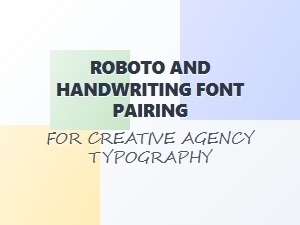 Roboto Pairs with Creative Handwriting Fonts
 Stylish Contrasts with Roboto for Minimalist Headers
 Roboto's Editorial Edge in a Slab Serif Contrast
 Roboto Modern Elegance with Decorative Serif Accents
 Roboto's Playful Partner Fonts for Upbeat Brands
 A Playful Companion for Roboto in Modern Headers